

Rebelmatic’s Creature on Sting the Devil, Survival, DIY, and Staying Free
Interview by Scott Pasch, DCxPC Live
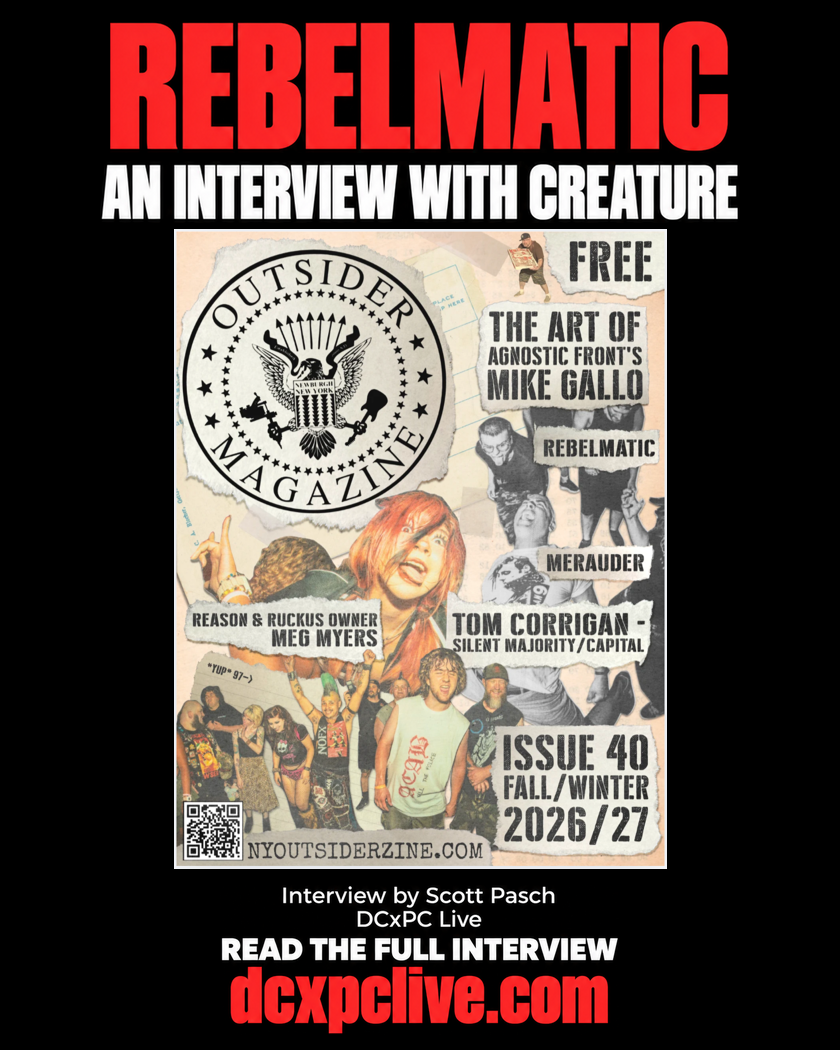
A shorter version of my interview with Rebelmatic vocalist Creature appears in the latest issue of Outsider Magazine. We had more to talk about than would fit in print, so I’m sharing the full interview here. If the magazine sent you this way, thanks for checking it out.
Creature and I got into Sting the Devil, the work behind DIY, survival and healing, and why Black punk bands deserve more than the same tired comparisons. We also talked about making room for everyday life while continuing to push the music forward. He even turned the questions around on me at the end.
Scroll down for full interview…
DCxPC Live Vol. 50 Rebelmatic - Preorder Starts 10/27
Sting the Devil and Alive on Arrival
Scott: I'm loving the singles for the new album, Sting the Devil. The title feels deliberate. You're not saying you can kill the devil; you're saying you can sting it. What is the devil in that title, and what does it mean to sting it?
Creature: First of all, it's a powerful statement. The devil is a system. To me, stinging the devil means living with awareness and consciousness, being your best self, and not falling victim to the traps that are set up for us to fail.
When you're younger, you sometimes believe everything can change through the force of music and people. I still believe there is power in that, but I also feel like change can be more gradual. Maybe that's the wisdom that comes with age. Part of me is still like, "Yeah, burn it all down," but sometimes you have to get your own shit together first. And I don't just mean financially. I mean as a person, as a human being.
For me, stinging the devil means not falling for the trappings they set up for us. It's about being your best self.
Scott: That idea of change starting internally feels like something you can hear across the record. If you don't do that work on yourself, you can't really change the system around you.
Creature: Absolutely. Being your best self is the same thing that punk music teaches you. If you don't hear something that reflects you, make it. If there are no bands saying what you want to say, say it. If you don't play, learn to play. If you say, "I'm not a vocalist," you can figure it out.
That's the wonderful thing about punk music. Sometimes we go so far outside ourselves, but there is a lot of junk in our own lives that we still need to figure out. That's what I'm about. It's internal to external.
Scott: Your first single from the album is "A.O.A. (Alive on Arrival)," which flips the phrase "dead on arrival." What is arriving alive right now? Is it Rebelmatic? New York City? The scene? Black joy?
Creature: It's all of that. It's a shift in the paradigm, especially in heavy music. There is an undercurrent of very nihilistic themes. We grew up with so much of that: "I'm dying," "I'm killing," and all of that. People do die, and negative things do exist in the world, but music is spiritual. When we chant a song, it becomes a prayer. Even if you're not religious or spiritually inclined, it becomes a mantra.
The way I'm wired, I don't want people chanting "dead on arrival." I'd rather have them chanting "alive on arrival." That raises the level of consciousness. It's Black joy, it's Rebelmatic, it's New York City, it's the music, but it's also the paradigm I'm adamant about shifting. I want to make sure we contribute to PMA, not just in music but in life.
Words are important. Actions behind those words make them more solid. That's why the song is called "Alive on Arrival."
Scott: You are in a band that people connect to hardcore and punk rock, and your vocal style can hit people as angry. What do you think people miss if they only hear the anger? What grief, humor, tenderness, exhaustion, or love are they missing inside the songs?
Creature: You just said it. If you think I'm only angry, you're missing all of that. You're missing the vulnerability, the passion, the loss, the frustration, and someone who has lived a real life.
For me, it is passion. It's hardcore. It's punk. So it comes out with that intensity. But there is always soulfulness in there. There is hope. There is vulnerability. There is light. Even with the anger, if you listen to the lyrics and how I'm delivering them, it's not just anger for anger's sake. It's righteous rage. It's justified.
Vocally, I don't sound exactly the same on every song. The cadence shifts. The tonality changes. There are different intonations and inflections. If all you catch is the anger, you're missing the whole thing. There is humor in there. There is passion. There is vulnerability. And it's fun. We're having fun. We're celebrating life, resistance, and resilience. It's all in there.
Scott: Rebelmatic has been a band a lot longer than some people realize.
Creature: We started in 2008. We're almost at twenty years now.
Scott: Thinking about that history and the new album, is there anything on Sting the Devil that you couldn't have sung ten years ago because you hadn't lived enough life yet? Not because you didn't have the writing ability, but because you weren't that person yet.
Creature: That's a good question. I'll talk about one song we did before first. "Born to Win" took almost ten years for me to write. I had it in my head for years. I knew I needed to write something uplifting, something that could be a theme. The idea was there, but emotionally I wasn't there yet. I hadn't lived it out enough for the words to pour out of me. Once I did, it came.
On this album, I don't know if there is one specific song that took that long, but I think the whole record comes from knowing what we do and knowing how to execute it better. The feelings are there, and now we know how to make them land.
I feel like this album sits somewhere between Ghost in the Shadows and Black Hole Eats the Tornado, but it's more expansive. We know exactly what we do. We've always known, but now it's more refined.
We never overthink our music. We think about the words, and we're thoughtful about creating it, but we're not sitting around saying, "This has to sound more hardcore," or "This has to sound more metallic." It's more like, "That's a great idea. Let's work on it." It's organic. When all four of us are in a room together, it's the most magical situation.
It took all the years of playing together, the last albums, and the touring to create the textures and the feel of this one. I don't know if there is one specific song, but the overall sonic palette could only happen now.
Making Room for Life
Scott: Being in a band is always more than just being in a band. There is a lot of grown-up, non-rock-and-roll life that has to happen behind the scenes. What was the most grown-up thing you had to deal with to get this album out?
Creature: See, this is why I love this guy. Scott gives you the real questions. I want to say this on the record for anyone who interviews us after this: don't keep giving me stock questions. I'll be respectful, but please do your homework. That's a fucking great question.
I have children. My children live with their mother in New Jersey, so there's dealing with children, child support, relationships, romantic relationships, friendships - just life.
From recording this album to now, we've lost a bunch of people close to us. Friends like Sacha Jenkins, Luqman, P. Fluid - Peter Forrest from 24-7 Spyz - and my homegirl Libby. Those were people close to us. Within the last year or couple of years, you lose a lot of people. With all the systemic things going on too, it becomes about keeping your humanity.
As we get older, guys have day jobs and responsibilities. It's, "Can we go on tour? When can you get off work? Can we pull off a week? Can we do a long weekend?" That becomes harder because everybody has grown-up responsibilities. But the love for the music always brings it back.
Honestly, for the first time in my life, I've enjoyed the mundane. I never really liked the mundane before. I was always like, "Let me get to what I really like to do." But over the last summer, I went to the beach a lot. I spent time with loved ones. I went to museums. I did regular life stuff. I saw my children, took them to movies, went to the park. I played Frisbee recently for the first time since I was a kid.
I went bowling this year. I used to hate bowling, but I was like, "I'll bowl." Then I asked myself, "Creature, what's wrong with you? Bowl. You're okay. You have permission to bowl." I gave myself permission to enjoy everyday life.
My mind has always been geared toward the home runs: tour, tour, tour, push, push, push. I'm still on that, but I also realized, "Let me go see my mother. My mother's still alive. My father's still alive. Let me spend time with my children. Let me go to the movies."
Before the last couple of years, I hadn't gone to the movies much. Now I've been more in the last two years than I had in probably the last twenty-five. I've been to the beach more than I ever have. It's really about remembering to live.
I changed how I eat. My colors are more vibrant. I dress differently because the outside reflects how I feel internally. I've given myself permission to be myself in my entirety.
Scott: Punk rock often romanticizes survival. We celebrate who made it through and mourn the people who didn't. What part of survival are you tired of celebrating?
Creature: Most of us who got into this music come from some kind of traumatic or fucked-up background. You don't usually get into this type of music because everything is right in your life, especially when you're young. I got into it around fifteen. You're young, you're angry, and you've probably been through some things.
At one point, a lot of it is trauma bonding. Misfits get around other misfits. Outcasts and outsiders find their tribe. It's like a Justice League. For a while, you hold onto that.
But something I've realized is that, for a lot of us, our identities are informed by survival and trauma. It's important to know what informed you, but it can become a badge of honor. Collectively, I don't think enough of us have worked on the healing.
It's hard to face abuse, insecurity, and all of those emotions. A lot of times we mask it with chemicals - alcohol, smoking, whatever it is - because we're not ready to deal with those emotions. But as we get older and lose friends and family, whether blood family or chosen family, you realize it isn't cool. It isn't cool to say, "He drank himself to death," or "She OD'd," like it's just part of the story.
There is pride in surviving a space where everyone didn't make it. But I also think the scene can be emotionally stunted. A lot of us are still teenagers emotionally. We may have businesses, children, and adult lives, but emotionally we haven't really worked on healing that inner child.
As I heal, there is certain music I can't even listen to anymore. I respect it as art, and I think everyone should have an outlet to release those feelings, but it doesn't speak to my spirit anymore. I don't want that on my spirit.
Rebelmatic on Its Own Terms
Scott: As Rebelmatic gets closer to twenty years, how do you keep the music from becoming old and safe? How do you keep it dangerous without simply repeating the same anger you had when you were younger?
Creature: The foundation is still the foundation. We're still Black men who grew up coloring outside the lines. We come from neighborhoods where the music we play wasn't the popular music. We were misfits and outcasts. We might look like the cool kids at the table now, allegedly, but we're still those guys.
There are still injustices in the world. There is still stuff that makes you say, "What the fuck is going on?" You need to express that. We're not millionaires in mansions trying to find the cool slogans of rage so we can captivate an audience. I still take the train. We still pay bills. We still deal with regular life.
We're also not trying to make the ultimate hardcore record or the ultimate punk record. We're trying to make the best Rebelmatic music. It is absolutely in the vein of hardcore and punk, but there is funk, hip-hop, soul, jazz, Latin music, and a lot of other elements in there too. We keep growing because we're growing as people.
We love Bad Brains, but we're not trying to recreate Bad Brains. We're not Bad Brains Jr. I love Sick of It All, but we're not trying to be Sick of It All Jr. We respect the people before us, the people alongside us, and the people coming after us. But we're us. We don't have to do anything except be us.
Scott: That leads into something I've been thinking about. A couple months back, I had Lake Lanier and Pucker Up! up in the Hudson Valley. I love both of those bands, and both have live albums coming through DCxPC Live. While they were here, I think Mia mentioned that they had been on a three-day run and, almost every day, someone told them they sounded like Bad Brains.
That automatic comparison happens to Black punk bands all the time, and it gets old. I went back through your interviews, and no offense to any past interviewers, but writers often flatten Black punk bands into the same reference points. In 2026, what is the lazy version of the Rebelmatic story you want people to stop telling - or what is the version you want them to tell?
Creature: Do your research and delve deeper. I love this interview right here because it's prepared. I love when people actually know our music, or at least study it enough to ask real questions.
All Black punk bands don't sound like Bad Brains. At the same time, I'll be the first to say we're influenced by Bad Brains. I've been fortunate enough to be in contact with a couple of them. I'm friendly with Darryl. I love Bad Brains, and I'm definitely influenced and inspired by them. I even have a Rebelmatic shirt that says, "Bad Brains changed my life," because they did.
But so did Public Enemy, Wu-Tang, Sly and the Family Stone, Death, and a lot of other people. I don't want to play down Bad Brains' influence, but it is lazy to always say, "You know who you remind me of?" I'm usually humorous with it because we've heard it so much. Every Black punk band has probably heard it.
For us, there is a positive message. We are very PMA oriented. The energy is palpable. I can see why someone would say we're in the lineage of Bad Brains. We're also in the lineage of Fishbone, 24-7 Spyz, and Living Colour. And if you go deeper, we're in the lineage of Sister Rosetta Tharpe, Bo Diddley, Chuck Berry, Little Richard, and Fats Domino.
I never want to disrespect that lineage or act like we created something out of thin air. But it's lazy to say every Black punk band sounds like Bad Brains. Do your homework.
Scott: Tom Morello once talked about being onstage and having people yell for Hendrix instead of yelling for "Free Bird," just because there was a Black guitarist onstage. It feels like people reach for the nearest identifier.
Creature: Inherent racism and white supremacy come out. That's just what it is. But people do this in other ways too. When I was young and Larry Bird was playing for the Celtics, any white guy who could shoot was called Larry Bird. Now any white kid who can rap a certain way gets compared to Eminem, even if he doesn't sound like Eminem at all.
People need identifiers. The more invested people are in a band, the more they can tell whether you're copying something or whether you're a genuine band inspired by different things. A lot of the time, though, it's just lazy.
The Work Behind DIY
Scott: You mentioned DIY earlier. Rebelmatic works with labels, but you still do a lot of things yourselves, and people don't always understand the unpaid labor behind that: favors, gas money, borrowed gear, door money, answering texts. What do you wish fans understood about what it takes to be a DIY band?
Creature: Yo, listen, another great question. It isn't just romantic. There is discipline and sacrifice involved in any art. Punctuality matters. Being on time matters. Returning emails and texts matters.
Someone in your band has to be the point person. Maybe not everyone can do it, but somebody has to say, "I responded to the email. I'll follow up. This is what we're getting. This is where we're staying." Someone has to take that responsibility.
People sometimes think it's just fun: get in the car, go on tour. You better love the music, because it's going to test that love. If you're only in it for fame, or attention, or to hook up with people, you're going to find out it isn't always what you think it is.
Be kind. Follow up. Have your head on straight. Ask questions if you don't know. Is there backline? Can we share? What do we need to bring? Is it a door deal? Is there a guarantee? Is there a place to set up merch? What's our time limit? Communicate with the promoter or whoever your point person is.
If you're running late and you don't tell anybody, that's a problem. If you cancel the day of the show but you knew two weeks ago you weren't going to play, that's a problem. If you're too cool to promote the show, that's a problem. You have to get your hands dirty. Put up flyers. Put up stickers. Email people. Text people. Respond.
Also know your strengths and your threshold. Some people like the idea of touring more than the reality. I just did nine shows in ten days. I'm built for that. I can do it. But that means playing forty-five-minute sets, screaming, jumping around, giving the same energy every day, getting up early the next morning to travel, and putting on my dancing shoes and smiling face. Not as a mask - that's just what we do.
Anyone who has been in the van knows it's a lot of work. It takes community and planning. In some ways, it's harder than working a nine-to-five because a nine-to-five tells you what you're getting. On tour, there is unpredictability. Venues change. Shows get canceled. Somebody drops off the bill. Guarantees disappear. You have to stay somewhere else.
Be prepared for discipline and sacrifice. Have a good attitude. Know that no one owes you anything. Be kind, considerate, and compassionate. There is too much entitlement, especially when people think they're the hot band. Kindness is better than being a jerk.
Scott: I try to turn toward kindness as often as I can. I'm not saying I never get angry or frustrated, but I try to ask, "What's the kindest way I can deal with this?"
Creature: We're human beings. We're not robots. There are emotions, frustrations, and disappointments. But you can still choose to be considerate and compassionate. Respect what people want to be called. Don't decide for them. Just be a human being. A lot of people have lost their humanity.
Writing for the Live Show
Scott: Your live energy is always impressive. The last time you were up here, Courtney from Tsunami Bomb was blown away and started texting her bandmates about Rebelmatic. When I first saw you, I immediately approached you about doing a live album. Did hearing that live album affect how you wrote songs going forward? Did it make you think about how new songs would translate live?
Creature: I go back and listen to that live album because it captures a powerful moment. But I don't know if it changed how we write, because our minds have always been on the live show. Most of the songs that make it to our albums have been played live first. That's been true since the beginning.
If we play something live and it doesn't work, I'm the first one to say, "Let's play it a couple more times. Maybe it's just new for people." But after the third time, if it still isn't hitting, we have to tweak it or get rid of it. I'm not here to make duds. If people aren't reacting, it's not always because they don't get it. Sometimes they just don't feel it.
We've played new songs before and people immediately said, "What is that?" So it's not about whether a song is new. It's about whether it hits.
That's why, when we record, we record together. Every record we've ever made has been recorded with us in the same room at once. We've never made an album where one person lays down drums, then someone else comes back next week to do guitar. We record together, then do overdubs and vocals.
For the new album, it was initially going to be an EP. We recorded the first five songs in about six hours - overdubs, vocals, everything. Then we decided to do more songs and make it a full album. We did another batch the same way. The reality is we probably could have done the whole album in six hours.
That's not ego. We know what we're doing. We play the songs out. We work them out. We practice before going into the studio. We're not playing games. We're tight and precise, but it's still punk.
If someone gave us enough money so nobody had to worry about day jobs and gave us a month in a house with a recording studio, we might come out with three records. I'm serious. We all write. We're always coming up with music. It wouldn't be junk either. We've been together almost twenty years, and individually everyone has more than thirty years of experience. We know our sound, and the Rebelmatic sound is not one-dimensional.
Reaching More People
Scott: Once Sting the Devil has been out for a while and it stops being the new record, what do you hope people have gotten from it? What do you hope it does for the band?
Creature: First, we're going to have Sting the Devil coffee coming out with Dark Matter Coffee. We'll have candles coming out, and hopefully some Sting the Devil hot sauce. So there will be some branding around the album.
But what do I hope people get? A heartfelt album. I want them to know all the words so that, when we play, they can sing with us as soon as the riff hits.
If you're already a supporter, you're going to love it. It fits with what we do. I don't know where it ranks in everything we've released, but it's absolutely one of our best records. If you're new to Rebelmatic, it's a great place to start. Then you can go back to Black Hole Eats the Tornado, Ghost in the Shadows, and everything else.
I hope it keeps opening doors. I want to do bigger tours. I hope that when people listen to it, it uplifts their lives a little. Maybe they put on Rebelmatic because it makes them feel good. Maybe it's cathartic. Maybe they work out to it. Whatever it is, I hope it affects them in a positive way.
I'm at a point where I feel like we can tour bigger things, keep doing what we're doing, keep building supporters, and grow organically without compromising who we are. This is our ninth release and our fifth full-length album. We have three EPs and a live album. There's also another live album with DCxPC Live coming soon - that should be out in the fall - so that will make ten releases.
We don't really need to release any more music anymore. Y'all need to catch up. But we're still recording, still writing, and still working. Black Hole Eats the Tornado came out last year, our live album is two years old, and now we've got another one coming. Our work ethic is pretty impressive.
I hope people enjoy it. Things are leveling up. Working with you has always been a great experience, and Creep Records has been really good. I think more opportunities are coming because we have the right mentality. Build it and they will come, right?
Most bands don't stick around more than a couple of years. We're almost twenty years in, and a lot of people still say, "Why am I just hearing about you?" The scene is fragmented. We play punk shows, hip-hop shows, and different kinds of bills. We get invited to punk festivals all the time, which is great. But we almost never get invited to hardcore festivals, which is bizarre to me because there is definitely enough hardcore in what we do.
But you don't choose your audience. Your audience chooses you. Who you play in front of dictates how people get to know you. We were never on a major label. There was never a bunch of money behind us. It has always been us putting out our own stuff, working with independent labels, and getting on the road.
I don't want Rebelmatic to be a band that people only appreciate after we're gone. I don't want people saying, "You missed them. They were one of the greatest bands." If you're alive right now and you hear about us, go see us. We're not kids. If you have an open mind and an open heart, there's a great chance you'll dig what we do.
I'm grateful for everyone who has supported us - everyone who came to shows, shared our music, bought merch, booked us, interviewed us, or put us on a festival. That community means something. I'm trying to have gratitude for the people already on the journey, because the next stuff will happen how it happens.
Scott: Some of that is regional too. I moved away from the Northeast in 2008 and was in Florida, so I didn't catch you until the things you were doing during the pandemic.
Creature: That's true, but it's also bigger than regional. We've been to Florida several times. We've been to the Midwest. We're going back to the Midwest. We've been through the South, the West Coast, and Toronto.
But if we're on tour with Weedeater, or on tour by ourselves, or playing with Leftover Crack, GZA, or whoever, different people are going to find us. If we were in the hardcore world opening for a big hardcore band for a month, more hardcore kids would hear us. If we were playing with Social Distortion, that crowd would hear us.
You can't overthink it. Stay steady and keep working. Otherwise you'll blow a fuse thinking about what-ifs and could-bes. Just play. Keep a good heart and play.
Playing Barefoot and Staying Free
Scott: One thing I've always noticed about your shows: you usually play in socks or barefoot. You even tried barefoot at Camp Punksylvania before the stage got too hot. Why no shoes? You're jumping around right in front of circle pits.
Creature: That barefoot Camp Punksylvania moment might have been the first time. I don't know why I tried it there. It was hot as shit. It was not a good move.
But I've been playing in socks for a long time. It started because I had sneakers that felt too heavy. I took them off and realized I felt more comfortable. Then it became a thing. Playing in socks made wherever I was feel like home.
Then the socks came off too, and I was even more comfortable. I'm not a hippie, even though I might be wearing tie-dye, but I do like the freedom of touching the earth. My nails might be polished, but I'm still going to jump around and do what I do.
It became a signal to people: be free. Be who you want. If we're really into the punk ethos, we have to be who we are. So I'm stripping it down. My shoes are off. My socks are off. I'm not up there just posing or looking cool. I'm there to sweat, engage, and get down and dirty with you.
I want to leave it all on the floor every time. There are people in front of us who paid and traveled to see us. I'm never going to take that for granted. When the shoes come off, it's time to go. I'm dialed in.
Sometimes I start with a hoodie on because I don't like performing cold. I like to get warm first. If the room is hot, I probably won't wear one. If it's cold, I put the hoodie on, generate the heat, and take it off. It's all part of getting ready. Now people expect me to be in socks or barefoot, and they're probably right.
Creature Turns the Questions Around
Creature: Before we get off, let me ask you something on the record. How do you compare Sting the Devil to our last couple of records, like Black Hole Eats the Tornado and Ghost in the Shadows?
Scott: To me, the songwriting is more dynamic. It sounds like Rebelmatic, but it doesn't retread anything. It feels fresh. You mentioned earlier that your vocals move through different cadences, tones, and inflections, and this record does all of that while still bringing new things in.
It sounds like an album made by a band that loves playing together. Some bands have one superstar member - the vocalist, guitarist, drummer, whoever - and everything revolves around that person. Rebelmatic doesn't feel like that. This album demonstrates the talent of each member. It feels like all four of you are necessary to the whole thing.
Creature: I appreciate that. I think we're all stars in our own roles, and together we become Voltron. The fifth member is the people. The audience makes it whole.
We're going to keep growing and evolving. We're not complacent. We're letting it naturally flow. And because we're not following a trend or chasing whatever the new sound is, we don't have to worry about that. We just keep being us.
Scott: That's one of the things I look forward to in Rebelmatic records. They always sound like Rebelmatic, but they don't feel like you are remaking the last album.
Creature: We're aware of that. Sometimes I hear music and think, "I've heard the same song fifteen times. I can't listen to this again." I never want to be that for myself.
We could make ten "Blood & Golds," but I would hate that. We already have "Blood & Gold." That's not the only thing we do. There is so much more terrain to travel. People don't always understand how much further we can take this. We're going to keep growing.
Sting the Devil lands as more than another Rebelmatic record. It captures a band still moving, still resisting easy categories, and still finding freedom in the work; rooted in punk and hardcore, but unwilling to be limited by either.